The Joint Entrance Examination Advanced (JEE-Advanced) is one of the most prestigious and challenging entrance exams in India. It serves as the gateway to the Indian Institutes of Technology (IITs), institutions globally recognized for their excellence in engineering and research. Every year, lakhs of students attempt to clear JEE-Main, but only a fraction qualify for JEE-Advanced, making it a test of true perseverance, knowledge, and analytical skills.
What is JEE-Advanced?
JEE-Advanced is the second stage of the JEE examination process. While JEE-Main acts as the qualifying test for most engineering colleges including NITs, IIITs, and GFTIs, JEE-Advanced determines admission specifically to IITs. Conducted by one of the IITs on a rotational basis under the guidance of the Joint Admission Board (JAB), this exam assesses not only subject knowledge but also logical reasoning and problem-solving ability.
JEE-Advanced vs JEE-Main
Key Differences Between JEE-Main and JEE-Advanced
While both exams fall under the umbrella of JEE, they serve different purposes:
JEE-Main is the qualifying test for most engineering colleges in India such as NITs, IIITs, and GFTIs.
JEE-Advanced is the exclusive gateway to IITs.
The difficulty level of JEE-Advanced is much higher, with more emphasis on analytical thinking and conceptual clarity, while JEE-Main focuses on speed and accuracy.
Eligibility Criteria for JEE-Advanced
To appear for JEE-Advanced, candidates must:
Be among the top 2,50,000 rank holders in JEE-Main.
Have completed their Class 12th or equivalent exam in the previous two years.
Meet age requirements (usually below 25 years, with relaxations for reserved categories).
Why JEE-Advanced is Considered Tougher
The exam is regarded as one of the toughest in the world due to:
Complex problem-solving questions.
Dynamic paper pattern, which changes yearly.
Limited seats in IITs, leading to fierce competition.
Eligibility and Reservation Criteria
Academic Qualifications
Candidates must have passed Class 12 or equivalent with Physics, Chemistry, and Mathematics. Minimum aggregate percentage requirements vary across categories.
Age Limit and Attempt Restrictions
Candidates can attempt JEE-Advanced a maximum of two times in two consecutive years.
General category students should be born on or after October 1, 2000, with age relaxation for SC/ST/PwD categories.
Reservation Policies
As per the Government of India norms:
27% seats reserved for OBC-NCL candidates.
15% seats for SC candidates.
7.5% seats for ST candidates.
10% seats for EWS category.
5% horizontal reservation for PwD candidates.
JEE-Advanced Exam Pattern
Number of Papers and Structure
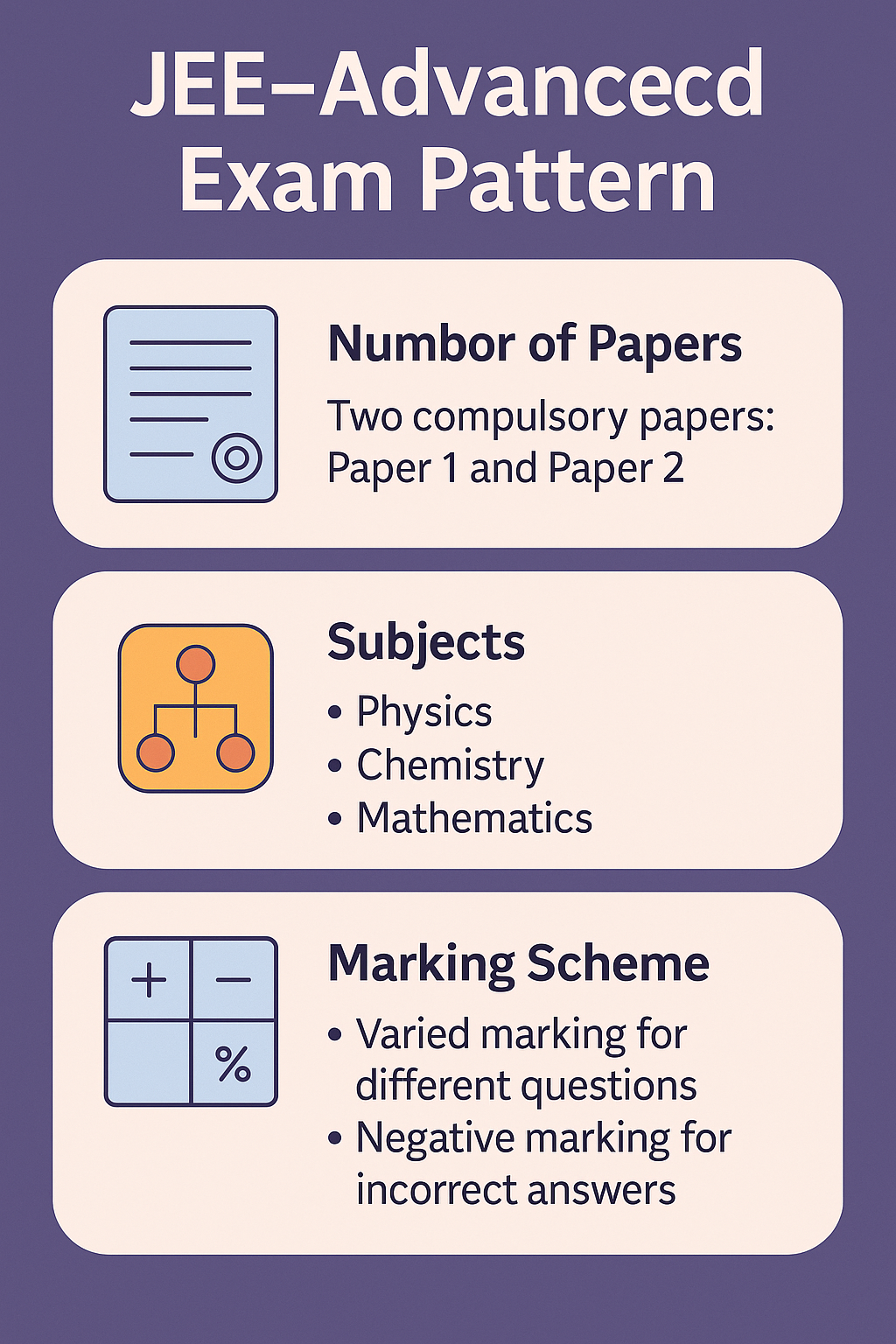
JEE-Advanced consists of two papers (Paper 1 and Paper 2), both compulsory.
Each paper includes Physics, Chemistry, and Mathematics sections.
Subject-Wise Distribution
While the number of questions may vary yearly, the exam usually includes:
Physics – Conceptual and application-based problems.
Coaching provides structure, competition, and expert guidance.
Self-study works for disciplined students with access to quality resources.
Mock Tests and Previous Year Papers
Solving mock tests under exam conditions builds speed, accuracy, and confidence. Past papers help identify trends and repeated concepts.
Time Management and Exam Tips
Daily Study Routine for JEE-Advanced Aspirants
Morning: Focus on theory and concepts.
Afternoon: Solve practice problems.
Evening: Revise previously studied topics.
Night: Take a mock test or analyze mistakes.
Tips for Effective Revision
Maintain a formula notebook.
Revise important derivations and reaction mechanisms regularly.
Use flashcards and mind maps for quick recall.
Handling Exam Stress and Pressure
Meditation, light exercise, and short breaks reduce burnout.
Mock tests simulate real exam pressure.
Positive mindset plays a big role in performance.
Role of Coaching Institutes
Top Coaching Institutes in India
Some of the most reputed coaching institutes that have consistently produced JEE-Advanced toppers include:
FIITJEE
Allen Career Institute
Resonance
Aakash Institute
Vibrant Academy
Bansal Classes
These institutes provide structured study material, regular mock tests, and mentorship from experienced faculty.
Online Coaching vs Offline Coaching
Online Coaching: Offers flexibility, self-paced learning, and cost-effectiveness. Popular platforms include Unacademy, Vedantu, and BYJU’S.
Offline Coaching: Provides a classroom environment, peer competition, and face-to-face guidance.
How to Choose the Right Institute
Check the track record of results.
Evaluate the faculty quality.
Consider the location, cost, and student-teacher ratio.
Success Stories and Inspirations
Toppers’ Strategies
Many JEE-Advanced toppers highlight:
Consistent revision and problem-solving.
Avoiding excessive distractions (especially social media).
Solving mock papers in real exam conditions.
Focusing on concept clarity instead of rote learning.
Lessons from IIT Alumni
IIT graduates often emphasize that JEE-Advanced preparation teaches time management, problem-solving, and perseverance, which are invaluable in life, even beyond academics.
Cut-Offs and Results
JEE-Advanced Cut-Off Trends
Cut-offs vary each year depending on exam difficulty, number of candidates, and seat availability.
Year
General Category Cut-Off (Out of 360)
OBC-NCL
SC
ST
2022
55–60 marks
50–55
40
35
2023
55–60 marks
50–55
40
35
Category-Wise Cut-Offs
Reserved categories enjoy lower cut-offs, ensuring equal opportunity for all aspirants.
Rank vs Marks Analysis
Top 100 rankers usually score above 300 marks.
Top 500 rankers range between 250–280 marks.
Admission chances depend not only on marks but also on subject-wise performance.
JEE-Advanced Counselling Process
JoSAA Counselling Explained
Conducted by the Joint Seat Allocation Authority (JoSAA).
Combines admissions for IITs, NITs, IIITs, and GFTIs.
Seat Allotment Procedure
Candidate registers on the JoSAA portal.
Fills in preferred IITs and branches.
Multiple rounds of seat allotment take place.
Students must freeze, float, or slide their allotted choices.
Choosing the Right IIT and Branch
Students often struggle between top IIT with a less popular branch or lower IIT with a core branch. Experts suggest focusing on long-term career goals rather than short-term prestige.
Career Opportunities After JEE-Advanced
Admission to IITs
Clearing JEE-Advanced ensures entry into India’s most prestigious IITs, offering world-class infrastructure, faculty, and opportunities.
Other Institutes Accepting JEE-Advanced Scores
Some premier institutes like Indian Institute of Science (IISc), Bangalore, and Indian Institutes of Science Education and Research (IISERs) also consider JEE-Advanced scores.
Career Paths After IIT
Engineering and Research in top companies.
Entrepreneurship (many IIT alumni are startup founders).
Higher Studies abroad in reputed universities like MIT, Stanford, and Harvard.
Common Challenges Faced by Aspirants
Procrastination and Distractions
Social media, gaming, and overthinking often lead to wasted time. Setting small daily goals helps tackle procrastination.
Balancing School and JEE Preparation
Since JEE preparation overlaps with Class 11 and 12 syllabus, students must learn to balance board exam studies with JEE practice.
Financial Constraints and Coaching Costs
High coaching fees discourage many aspirants. However, scholarships, free online resources, and government schemes are available to support meritorious students.
Latest Updates About JEE-Advanced
Mode of Examination
Conducted in Computer-Based Test (CBT) mode.
Available in English and Hindi (some regional languages introduced in recent years).
Registration and Fees
Candidates register online at the official JEE-Advanced website.
Fee ranges from ₹1,400 (reserved categories) to ₹2,800 (general category).
Q1. How many times can I attempt JEE-Advanced? You can attempt JEE-Advanced a maximum of two times in two consecutive years.
Q2. Can I get admission in IIT without JEE-Advanced? No. JEE-Advanced is the only way to secure a seat in an IIT.
Q3. Which subjects are most important for JEE-Advanced? All three subjects—Physics, Chemistry, and Mathematics—carry equal weight, though Mathematics often has slightly tougher questions.
Q4. What rank is required to get into IIT Bombay or IIT Delhi? Typically, a rank within Top 1,000 is needed for Computer Science in IIT Bombay or Delhi.
Q5. Is NCERT enough for JEE-Advanced? NCERT is essential for basics, but for JEE-Advanced, students must practice from advanced-level books and mock tests.
Q6. What if I don’t clear JEE-Advanced? You can still pursue engineering through JEE-Main colleges (NITs, IIITs, GFTIs) or private institutions.
Conclusion
Cracking JEE-Advanced is not just about intelligence—it’s about discipline, dedication, and determination. With proper planning, the right resources, and a positive mindset, any aspirant can achieve success in this challenging exam. Beyond IITs, the journey of preparation itself equips students with problem-solving skills and resilience that last a lifetime.